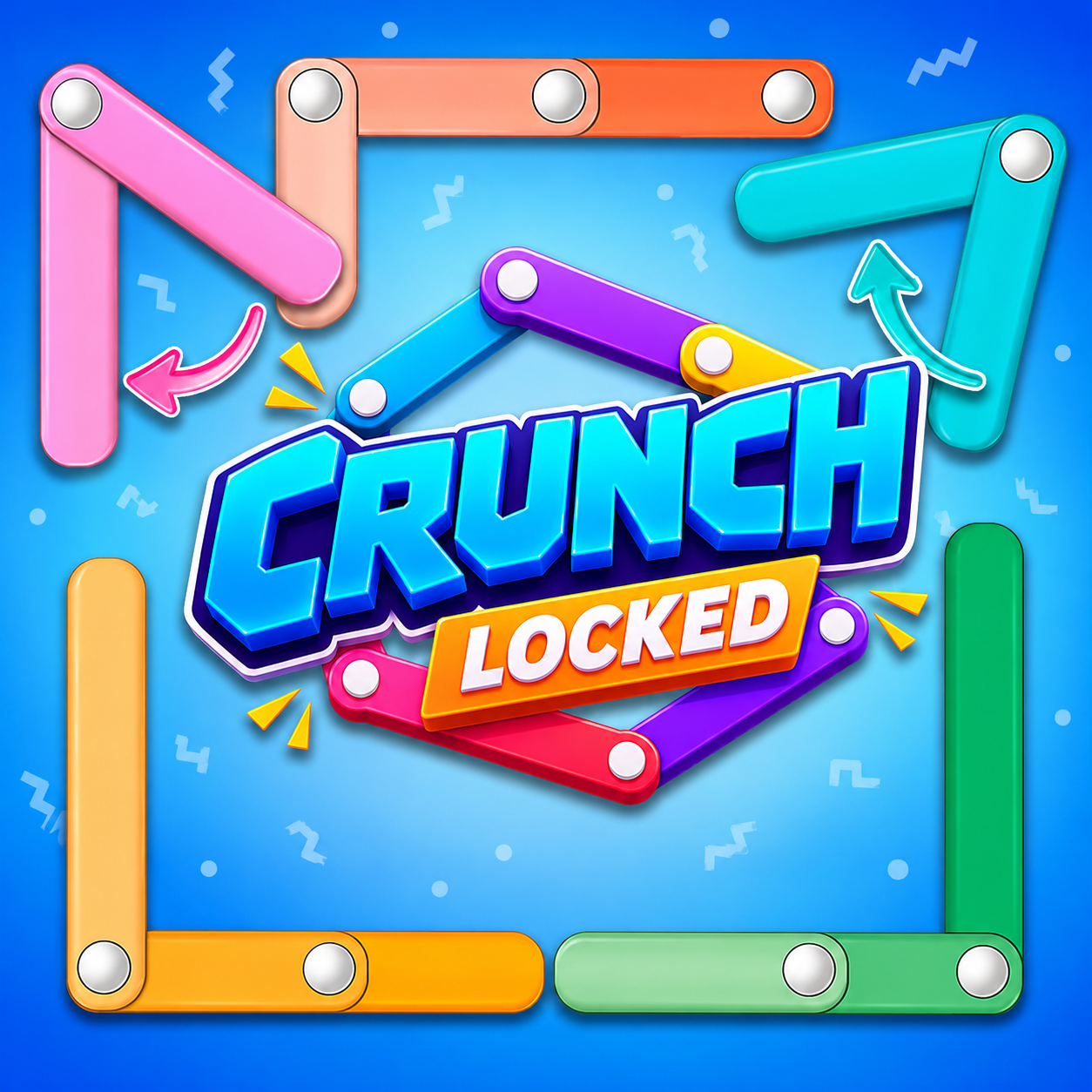
Crunch Locked
Crunch Locked Mods Game
Sprunki Phase 5 The Blackened Killer Remake

Candy Jump

Backyard Dig Hole 3d

Racing In City

Snakelandsio
Backrooms
Sprunki Rareshifted But Shifted
Blocky Runner
Jelly Runner
Brainrot Park
Neon Rush
Parking Adventure
Temple Of Boom

Retro Sports Champion
Bowling Master

Survival Race
Escape From Tsunami Brainrot

Aqua Bits

Sprunki Fake Skymon
Sprunki Phase 2 5 Definitive Edition Old Version

How To Play Crunch Locked
The fundamental interaction in Crunch Locked is remarkably intuitive: players click (on desktop) or tap (on mobile) any movable segment to rotate it 90 degrees clockwise. However, the underlying logic governing which segments can be moved at any given moment is the heart of the gameplay. Each level begins with a chaotic cluster of connected segments, arranged in a two-dimensional space. The player’s goal is to fold these segments one by one until the entire structure collapses into nothingness.
To achieve this, players must understand the two types of segments: free segments and locked segments. Free segments can be rotated immediately; their path is unobstructed, meaning no other piece blocks the arc of rotation. Locked segments, by contrast, are marked with a visual indicator (often a padlock or distinct color) and cannot be rotated until the obstacles preventing their movement are removed. These obstacles typically consist of other segments that overlap or cross the locked piece’s intended rotation trajectory. The challenge lies in determining the correct sequence of moves: players must first clear free segments to create space, which may then unlock previously inaccessible pieces. The rotation is always 90 degrees clockwise, so each move fundamentally alters the spatial relationships between segments. A piece that was once blocked may become free after its neighbor is folded away, and vice versa—a piece that was free may become locked if the structure collapses onto it in an unexpected way.
Mastery of the game requires players to visuali
Crunch Locked Wiki
Summary
Crunch Locked is a meticulously crafted puzzle game that challenges players to unravel tangled structures through sequential folding. At its core, the game presents a deceptively simple objective: fold every movable segment until the entire configuration disappears. However, beneath this straightforward premise lies a deeply strategic experience that demands logical reasoning, spatial awareness, and forward planning. Each level introduces a fresh arrangement of interlocked segments, some freely rotatable and others locked behind obstacles. The player’s task is to identify the correct order of moves—rotating each available piece 90 degrees clockwise—while respecting the constraints imposed by overlapping paths and blocked pieces. The game’s progression steadily escalates in complexity, ensuring that early levels serve as a gentle introduction to its mechanics, while later stages test even seasoned puzzle enthusiasts. Crunch Locked distinguishes itself by offering a serene yet intellectually rigorous atmosphere, where the satisfaction of a solved puzzle is earned through careful deliberation rather than speed. It appeals to those who appreciate logic puzzles that reward patience and systematic thinking, and it provides a refreshing alternative to action-heavy or time-driven games. By stripping away extraneous elements and focusing on a single core mechanic, Crunch Locked delivers a pure, unfiltered puzzle experience that is accessible to newcomers yet deep enough to engage veterans.
ze the puzzle in three dimensions? Even though the display is flat, the folding action implies that segments pivot around their attachment points, changing their orientation and often their position relative to other segments. Players must track which pieces are currently movable, which are locked, and which moves are safe to execute without creating dead ends. The game does not penalize mistakes; players can undo moves or restart the level, but the true reward comes from solving the puzzle with the minimum number of rotations. For complex levels, trial-and-error is natural, but the most efficient solvers will study the entire layout before making a single move. By systematically evaluating each segment’s current state and predicting how each rotation affects the whole, players can unravel even the most tangled puzzles with elegance and precision.
Key Features
Crunch Locked boasts several distinctive features that elevate it above typical casual puzzle games. First and foremost is its innovative folding mechanic. Rather than sliding, swapping, or matching tiles, the game asks players to rotate interlocking segments in a confined space. This unique interaction creates a puzzle type that feels fresh and mentally stimulating. The progressive difficulty curve ensures that the learning process is natural: early levels introduce simple two- or three-segment puzzles, while later stages present sprawling networks of up to a dozen pieces, often with multiple locked segments that require careful sequencing.
Another standout feature is the locked piece system. By designating certain segments as immovable until others are cleared, the game introduces a hierarchy of moves that forces players to think in terms of cause and effect. This mechanic prevents random clicking from being a viable strategy and rewards methodical planning. The clean, minimalist visual design also deserves mention. The segments are clearly distinguishable, with locked pieces visually marked, and the interface lacks distracting elements. This clarity allows players to focus entirely on the logical puzzle at hand. Additionally, the game includes undo and reset functionality, which encourages experimentation without frustration. Players can safely test a sequence of moves and backtrack if they reach a dead end.
The responsive controls across both desktop and mobile platforms ensure a seamless experience. On desktop, left-clicking a segment rotates it; on mobile, a simple tap suffices. The game also provides tactile feedback—a subtle sound and visual cue when a rotation is successful—which reinforces the sense of progress. Moreover, the lack of time pressure is a deliberate design choice. Crunch Locked is a relaxing puzzle game; there are no timers, no scoring systems, and no penalties for slow play. This allows players to immerse themselves in the logic at their own pace, making it an ideal choice for unwinding after a long day or for engaging in deep, focused thought sessions.
Precautions/Tips
While Crunch Locked is accessible and forgiving, certain strategies can significantly enhance a player’s success and enjoyment. The most important tip is to resist the urge to click randomly. Many players, especially when stuck, fall into the trap of rapidly rotating segments in the hope that something will work. This approach rarely solves complex puzzles and often leads to a more tangled state. Instead, take a moment to study the full layout before making any moves. Observe how segments overlap, which pieces appear to have clear paths, and where locked segments are positioned relative to free ones. This preliminary analysis can save numerous undo cycles.
Another critical precaution is to prioritize clearing free segments first. Locked pieces are designed to be solved later; trying to force them early is futile. Focus on rotating all movable segments until no free pieces remain. At that point, new segments may have become free, and the puzzle’s progression becomes clearer. It is also advisable to plan two or three moves ahead. After a segment rotates, the configuration changes. Anticipate how that rotation will affect the paths of neighboring pieces. If you can visualize the state after a sequence of moves, you are far less likely to create an unsolvable dead end.
Players should also pay attention to the direction of rotation. Since every rotation is 90 degrees clockwise, a segment that is currently upright will become horizontal, and vice versa. This may seem trivial, but in tight spaces, the orientation determines whether a segment will collide with others. Use the undo feature freely. There is no penalty for backtracking, so do not hesitate to try a hypothesis and revert if it fails. Finally, for particularly difficult levels, step away and return later. A fresh set of eyes can often spot a solution that was previously invisible. Patience and deliberate observation are the cornerstones of success in Crunch Locked; speed is irrelevant. By embracing these practices, players can transform each puzzle from a frustrating tangle into a satisfying mental workout.
Crunch Locked Frequently Asked Questions
Q: What is Crunch Locked?
A: Crunch Locked is a relaxing yet challenging puzzle game that tests your logic, observation, and planning skills. Each level presents a group of interlocked segments that must be folded away in the correct order until the entire structure disappears.
Q: How do you play Crunch Locked?
A: You start with several connected segments arranged in a tangled pattern. Your goal is to fold every movable piece until the structure is completely cleared. Clicking an available segment rotates it 90 degrees clockwise, but a segment can only move if another piece is not blocking its path.
Q: What are the controls for Crunch Locked?
A: On desktop, use the mouse to left-click a movable segment to rotate it 90 degrees clockwise. On mobile, tap a movable segment to rotate it clockwise.
Q: What are locked pieces in Crunch Locked?
A: Locked pieces are segments that cannot be moved immediately. They are marked as "Locked" and will not rotate until nearby obstacles have been removed.
Q: How do you unlock a locked piece?
A: Focus on the freely movable segments first. Clearing these pieces creates space and may unlock restricted parts later in the puzzle. Pay attention to the position, direction, and layering of each segment.
Q: What is the goal of each puzzle in Crunch Locked?
A: The goal is to fold away all interlocked segments in the correct sequence until the entire structure disappears.
Q: What tips are there for solving difficult levels in Crunch Locked?
A: Study how the segments overlap before making a move. Start with freely movable segments, then use those moves to open paths for locked or restricted pieces. Plan several steps ahead instead of reacting to one move at a time. Patience and observation are more useful than speed.
Q: Why should you avoid clicking randomly in Crunch Locked?
A: Clicking randomly can cause unnecessary rotations and mistakes. Successful players study the full puzzle before making their first move to reduce errors.
Q: What should you do before making your first move in a level?
A: Take a moment to study how the segments overlap and look for pieces that can move without being blocked. Review the entire layout to identify the correct sequence.
Q: Is Crunch Locked available on mobile?
A: Yes. On mobile devices, you tap a movable segment to rotate it clockwise, just like left-clicking on desktop.
Q: What genre does Crunch Locked belong to?
A: It is a casual puzzle logic game.
Q: How can you report a bug in Crunch Locked?
A: There is a "Report a bug" option. You can select the issue (e.g., game doesn't load, game not working, lost progress, inappropriate content, help with purchase, suggestion, other) and send it.
Q: How can you share Crunch Locked with friends?
A: You can copy the link provided in the "SHARE WITH YOUR FRIENDS" section.
Q: How do you leave a comment on the game page?
A: There is a comment section where you can type a comment. You must read and agree to the terms and conditions before posting.
Q: What issues can you report in Crunch Locked?
A: The available options are: "The game don't load", "The game is not working", "I lost my progress", "I saw something inappropriate", "I need help with an in-game purchase", "I have a suggestion", or "Other".