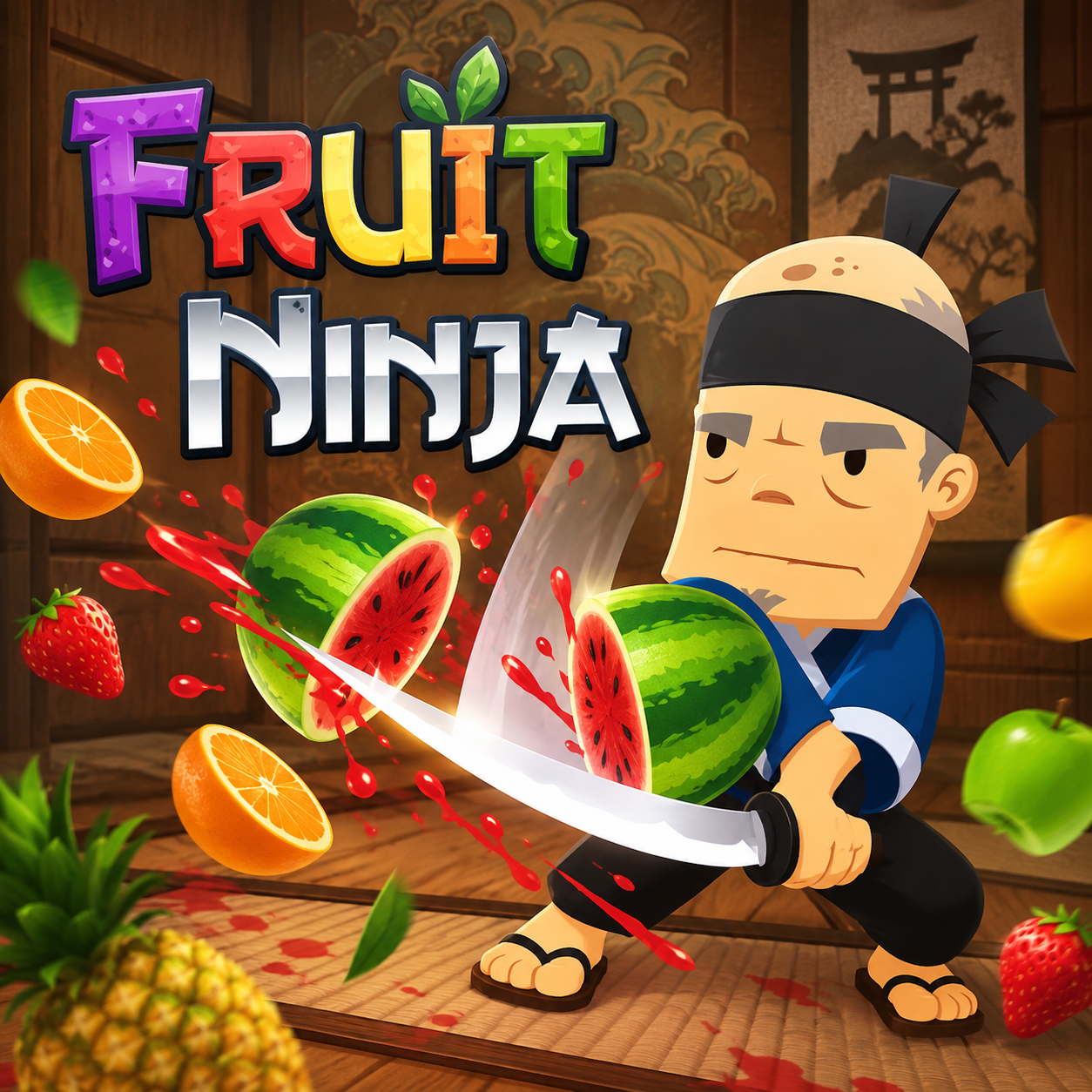
Fruit Ninja
Fruit Ninja Mods Game
Zombie Battle Royale

Dash Masters
Zombie Dash
Rainbow Tsunami
Shapik The Quest

Do Dragons Exist
Goat Rampage
Tower Rise

Horror Nun 2

Sprunki Square Shifted
Obby Survive Parkour

Bees Empire Clicker

Paint Or Hunt

Super Bear Adventure
Brave Squad

Sprunki Hyper Shifted Phase 3 Remastered

Left Or Right Spranki Beats

1 Speed Keyboard Lucky Escape
Traffic Racing
Rider Rush



How To Play Fruit Ninja
The core mechanics of Fruit Ninja are simple to grasp, yet mastering them demands considerable practice. The objective requires the player to slice fruit propelled upward from the lower edge of the display. Every item follows a curving ballistic path: it ascends, decelerates as it reaches the apex of its flight, and then speeds up on its way down. To cut the fruit, one must drag the blade across the visible body of the target. On a desktop setup, this involves holding the primary mouse button while moving the pointer. On mobile devices and tablets, a simple finger swipe across the screen accomplishes the same action.
The trajectory of the blade is just as crucial as the timing of the cut. Given that the slicing motion is uninterrupted, a single sweeping gesture can slice multiple pieces of fruit within one fluid movement. This mechanic forms the basis of the combo system. Cutting several targets in a single stroke awards substantially more points than dealing with them one by one, and experienced players deliberately plan their swipes to intersect numerous pieces at once. At the same time, the player must remain mindful of bombs. These dangerous objects are visually distinctive and either end the session in Classic mode or deduct points in Arcade mode. An overly broad swipe can easily hit a bomb concealed just beyond the intended slicing path.
Successful play begins with careful observation. Because fruit decelerates at the top of its trajectory, that point often provides the ideal opportunity to assess its exact position and select a safe cutting angle. Holding off for just a fraction of a second may allow several pieces to converge, making a diagonal stroke especially effective. However, delaying too much raises the risk of the fruit falling beyond reach. This means each movement demands a careful balance between quickness and accuracy.
In Classic mode, the lack of a timer encourages a more patient play style. The goal is simply to keep the round going while avoiding errors. Letting three fruits fall without slicing them ends the game, while touching a bomb leads to an immediate loss. Consequently, players should occasionally let a difficult fruit drop if slicing it would require cutting through an adjacent explosive. In Zen mode, bombs are entirely absent, and dropped fruit carries no penalty whatsoever. This produces a relaxed, low-stress setting where players can devote their attention to fluid, well-timed strokes and practice combining multiple targets into a single combo sequence.
Arcade mode alters the dynamics by adding a countdown timer and imposing a point penalty for bombs. Missed fruit is not penalized, allowing players to focus entirely on scoring at maximum speed. The introduction of bonus bananas—such as Freeze and Double Points—adds another strategic dimension. Freeze temporarily slows the action, while Double Points increases the score value of every piece sliced during its duration. Recognizing when to pursue these enhancements and when to focus on sustaining the combo flow is an essential skill for achieving mastery in Arcade mode.
Fruit Ninja Wiki
Summary
Fruit Ninja operates as a precision-based action experience that compresses the classic arcade cutting formula into a challenge revolving around timing, spatial perception, and measured assertiveness. At its core, the premise is straightforward: pieces of fruit are propelled upward, and the player must cut as many of them as feasible while steering clear of dangerous hazards. However, the game’s real sophistication emerges in how one reads the flight path of every element on screen, determines the right moment to unleash a broad sweeping motion, and recognizes when a precise single cut outweighs the reward of a risky multi-target slash.
The player’s blade mirrors the exact route traced by the mouse or fingertip, so each slice becomes a direct representation of the player’s deliberate intention. Fruit climbs from the lower edge of the display, loses momentum near the apex of its trajectory, and then drops back beyond reach. This creates a consistent rhythm: early slashes are relatively safe but yield limited returns, whereas holding out for multiple pieces to converge presents the opportunity for substantially higher combo scores. Bombs are interspersed throughout the airborne clutter and must never come into contact with the blade, introducing a layer of risk evaluation to every decision made.
Fruit Ninja presents three separate game modes, each carrying its own objective and scoring philosophy. Classic mode centers on endurance with no time constraint, and the session concludes only after three fruits are missed or a single bomb is struck. Zen mode delivers a 90-second, bomb-free setting for players who wish to concentrate on flawless mechanics and combo construction. Arcade mode functions as a 60-second scoring rush in which dropped fruit incurs no penalty, bombs subtract points rather than terminating the run, and special bananas have the ability to reshape the pace of play. Collectively, these modes convert a simple cutting mechanic into a versatile skill-based title that accommodates both cautious planners and aggressive point hunters.
For dedicated gaming enthusiasts, Fruit Ninja offers far more than a casual diversion. It prizes pattern recognition, eye-hand synchronization, and disciplined choice-making. The controls are instantly intuitive, yet the scoring structures and bomb placements guarantee that true proficiency demands consistent focus and intentional, repeated practice.
Key Features
Fruit Ninja’s construction relies on a compact collection of core elements that together deliver a surprisingly intricate gameplay experience. The most conspicuous element is the effortless swipe-driven cutting mechanic. Given that the blade faithfully follows the user’s exact input path, there is no character animation or projectile lag separating intention from execution. This direct control scheme makes the title simple to pick up while still preserving a meaningful ceiling for advanced skill.
The three playable modes form a central pillar of the game’s appeal. Classic mode supplies a survive-as-long-as-possible challenge. With no timer present, every choice carries consequence: a single miscalculation can end the run, yet a patient and meticulous approach can prolong it indefinitely. Zen mode offers a 90-second relaxed interval with no bombs and no penalties for missing fruit. It serves as the perfect practice arena for learning fruit movement and refining combo timing. Arcade mode, on the other hand, provides a 60-second scoring blitz. The absence of miss penalties promotes bold behavior, while the bomb deduction system reins in complete recklessness.
Combo scoring stands as another essential trait. By slicing several fruits within one continuous stroke, players accumulate considerably higher point totals than they would by performing individual cuts. This pushes the player to think in terms of overarching trajectories rather than isolated swipes. Successful runs are constructed around long, purposeful diagonal movements that sweep through the upper region of the screen, where fruit tends to gather most densely. The demand to preserve accuracy while moving quickly generates a persistent cognitive challenge.
The inclusion of bombs adds a risk-and-reward dimension to every slash. Bombs are intentionally positioned among the fruit, compelling the player to remain conscious of the entire display at all times. In Classic mode, a single bomb proves fatal. In Arcade mode, bombs merely reduce the score and allow the session to continue. This distinction shapes how players approach each mode: a cautious mindset dominates Classic, while deliberate risk-taking defines Arcade.
Finally, the cross-platform nature of the controls makes Fruit Ninja a highly adaptable experience. The game performs equally well on desktop setups using a mouse and on touchscreens using a finger. The underlying mechanics stay uniform, so abilities sharpened on one platform transfer smoothly to the other. That combination of approachability and scoring-system depth renders Fruit Ninja a worthwhile title for gamers who appreciate experiences that are simple to learn yet genuinely difficult to conquer completely.
Precautions/Tips
The most essential precaution in Fruit Ninja is to examine the entire trajectory before committing to a cut. Because the blade slices through every object located along its route, a broad or careless swipe can easily intersect a bomb. Players should visualize an invisible line from the starting point of the intended swipe to its endpoint and confirm that every object lying on that line is safe to strike. If a bomb sits close to a fruit grouping, shorten the stroke and accept a reduced combo. Earning a smaller score is always preferable to losing the entire run.
In Classic mode, survival must remain the foremost priority. The round does not conclude when a single fruit is missed; it ends only after three misses or one bomb hit. This means that a deliberate miss is occasionally the most intelligent decision. If a fruit is positioned directly next to a bomb, or if the only route to reach it requires crossing an explosive, the better choice is to allow that fruit to fall. Absorbing one miss causes far less damage than bringing the whole run to an abrupt halt. Newcomers often fall into the trap of attempting to slice every fruit visible, but experienced players recognize that certain pieces are deliberately placed as bait.
Zen mode provides the safest environment for practicing and honing technique. By eliminating bombs and erasing any penalty for missed fruit, it isolates the fundamental elements of timing and combo construction. Players who find it difficult to strike multiple targets should use Zen mode to test different swipe angles and stroke lengths. Take note of where each fruit reaches its lowest velocity, as that point offers the simplest opportunity for interception. Practicing diagonal strokes that travel from the lower corners toward the upper center can help instill the muscle memory required for high-scoring performances.
In Arcade mode, the main priority is scoring velocity, but players should not completely disregard bombs. A bomb costs only 10 points, while a successful combo can yield far greater returns. Consequently, it is occasionally worth making a dangerous swipe if the payoff includes a substantial multi-fruit combo. That said, players should still minimize unnecessary bomb contacts, especially when the Freeze or Double Points banana is active. During a Double Points bonus, every piece of fruit carries twice its normal value, making bomb avoidance even more critical. Reserve aggressive risk-taking for moments when the possible gain clearly outweighs the penalty.
Finally, keep in mind that the blade can be as narrow or as expansive as the player decides. Short, quick strokes work best in congested areas where bombs are likely to be concealed. Longer strokes generate greater combo momentum but cover more ground and therefore introduce additional risk. Adjust the length and direction of each swipe according to the current arrangement of objects on screen. By staying flexible and consistently reading the display before making a cut, players can transform a simple swipe into a high-scoring performance that never touches an explosive.
Fruit Ninja Frequently Asked Questions
Q: What is Fruit Ninja?
A: Fruit Ninja is a game centered on skill in which players slice pieces of fruit as they are launched across the display, string together multi-fruit sequences, and steer clear of explosives hidden among the fruit. The game features three distinct modes, each with its own set of rules and varying degrees of difficulty.
Q: What are the three game modes in Fruit Ninja?
A: The three available modes are Classic, Zen, and Arcade. Classic mode operates without a time constraint and concludes when three fruits are missed or an explosive is struck. Zen mode lasts for 90 seconds, contains no bombs, and imposes no penalty for fruits that are missed. Arcade mode presents a 60-second scoring contest with no penalty for letting fruit fall, although hitting a bomb removes 10 points.
Q: How does Classic mode work?
A: Classic mode has no predetermined time limit. The session ends once three fruits slip past you or a bomb is sliced, unless a protective item intervenes to save you. Maintaining accuracy keeps your run alive, so there are moments when allowing an awkward fruit to drop is a wiser choice than slicing through an explosive.
Q: How does Zen mode work?
A: Zen mode gives you a 90-second window with no bombs and no consequences for missed fruit. This mode is intended for honing clean cutting techniques and grouping several targets into combos, all without the pressure of staying alive.
Q: How does Arcade mode work?
A: Arcade mode is a 60-second scoring sprint packed with bonus actions and no penalty for dropped fruit. Bombs reduce your score by 10 points rather than terminating the round, so the main objective is gathering points quickly while minimizing expensive mistakes.
Q: What are the controls on desktop?
A: On desktop, you hold down the left mouse button and drag the cursor through the fruit in order to slice it.
Q: What are the controls on mobile or tablet?
A: On mobile or tablet devices, you simply swipe your finger across the touchscreen to slice through the fruit.
Q: How do combos work in Fruit Ninja?
A: Your blade follows the exact path you trace, which means a single uninterrupted stroke can slice through multiple pieces of fruit and yield combo bonuses. Using long, sweeping diagonal motions can help you cut several fruits simultaneously when the trajectory is unobstructed.
Q: How do bombs affect gameplay?
A: Bombs add an extra layer of timing difficulty. A broad slash might catch a whole cluster of fruit, but it can also hit an explosive positioned right next to them. In Classic mode, making contact with a bomb ends the run immediately. In Arcade mode, bombs result in a 10-point penalty instead of a game over. Zen mode contains no bombs at all.
Q: What are the Arcade bonus items?
A: Arcade mode features the Freeze banana and the Double Points banana. Slicing the Freeze banana slows down the on-screen action, while slicing the Double Points banana boosts your scoring potential.
Q: How does fruit movement work?
A: Fruit ascends from the lower part of the screen, decelerates as it reaches the peak of its trajectory, and then descends beyond reach. Near the apex of their flight paths, fruit becomes much simpler to follow, which makes that moment ideal for planning your slicing angle.
Q: What tips are there for a higher score?
A: Useful tips include lining up combos using long, diagonal swipes; inspecting your intended path for bombs before committing to a cut; prioritizing Arcade bonuses such as Freeze and Double Points bananas; and spending time in Zen mode to become familiar with fruit trajectories and sharpen your timing before taking on Classic or Arcade.
Q: When is the best time to strike fruit?
A: Slicing right away is effective for catching individual pieces of fruit, while pausing briefly can draw multiple targets into the range of one swipe. Fruit is easier to follow near the highest point of its arc, giving you a valuable window to line up the correct angle.
Q: Should I always go for large combos?
A: No. Always examine the complete path before making a cut, and opt for shorter strokes when dangerous objects are close to the fruit. Strong performances depend on judging whether a large combo is worth the gamble, particularly when bombs are positioned nearby.