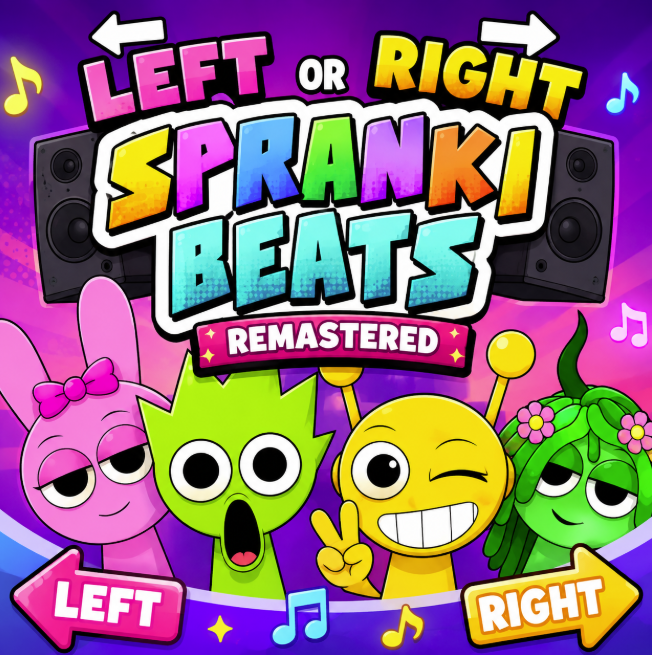
Left Or Right Spranki Beats
Left Or Right Spranki Beats Mods Game

1 Speed Keyboard Lucky Escape

Traffic Racing

Rider Rush
Sprunki Phase 9 Ggtp

Rooster Road

Please Do Not Feed The Sprunki Brud
Endacopia

Basketball Hit
Flying Car Game Police Games
My Talking Tom Cat But With Oren
Park Fever

Goalheads Io

Flip Or Fail
Classic Sudoku Puzzle

Skillful Finger
Tomb Of The Mask Neon

Boboiboy Galaxy Run

Sprunki Footlongs Sandbox
Hamster Maze
Blobade

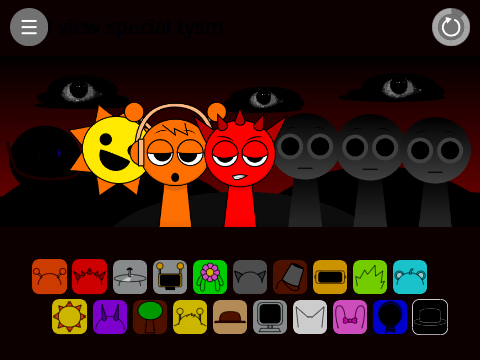

How To Play Left Or Right Spranki Beats
In Left Or Right Spranki Beats, upon entering the game, every player is presented with a lineup of available tracks. It is advisable to start with a less demanding track first, allowing you to grasp the core rhythm and understand how prompts evolve. The mechanics are straightforward: cues appear on screen, signaling whether to respond on the left or the right. You then register your choice by tapping or pressing the key that matches the indicated side. Precision matters here: your input must align with the beat's timing rather than relying solely on remembering the order of prompts.
The opening stage functions as an interactive tutorial, progressively introducing more cues and setting the overall tempo. For newcomers, a straightforward approach is to focus on the display zone and wait for the visual command to appear. Simultaneously, pay attention to the musical rhythm and try to synchronize your response with it. Randomly clicking as fast as you can will lower your score, as the game penalizes thoughtless button mashing. Rather, timing takes precedence over raw speed. Across all modes, the basic rule stays constant: choose left or right whenever a cue is presented. However, the form and character of those cues can vary significantly.
The Four Modes:
-
Left or Right (Classic) – This is the original and most basic mode. Cues are shown as directional arrows or text reading “LEFT” and “RIGHT.” The visual indicator and the musical accompaniment are presented simultaneously, offering a combined signal that helps you build a quick connection between what you see and what you hear.
-
Sound-Only Mode – In this variant, all direct visual guidance is stripped away. Instead, you rely on a distinct audio cue—such as a sound panned sharply to the left or right, or a melodic note emerging from a specific channel. Your task is to identify the source side and respond appropriately. This mode sharpens your listening skills and challenges your sensory reaction time.
-
Visual Prompt Mode – Here, the musical directional hints are muted, and the game relies entirely on a visual trigger—for instance, a flash of color or an object moving on one side. This requires almost subconscious processing, and the difficulty escalates as the tempo accelerates.
-
Pattern Shift Mode – This mode combines elements from the others. The cues themselves can remain, but the defining feature is that the rules can shift mid-song—for example, you might suddenly need to pick the opposite side, or the left and right positions could be mirrored. Staying alert to these changing conditions is essential.
All four modes preserve the apparent simplicity of choosing left or right, yet each one introduces a fresh cognitive challenge. Regularly moving between them trains the brain to make sharper distinctions and adapt quickly.
Left Or Right Spranki Beats Wiki
Summary
Left Or Right Spranki Beats is a creative rhythm experience that reduces the genre to its fundamental decision: choosing between two sides in perfect time with the music. Unlike mainstream rhythm games that rely on elaborate button sequences, scrolling note highways, or overwhelming visual effects, this title pares everything down to a single, elegant question—will your next selection be left or right? The outcome is a compelling fusion of reflex testing, pattern recognition, and auditory awareness, delivering the excitement of a rhythm action game without complicated controls or cluttered displays.
The concept is straightforward: while a track plays, the game presents cues that indicate which side of the screen to activate. In its simplest form, the player selects the correct side to match the cue. Synchronized with the accompanying music, every attempt maintains rhythmic consistency and creates a sensory connection between what is heard and what is performed. The design philosophy prioritizes accessibility—anyone can grasp the core loop within seconds—but the increasing tempo and shifting patterns ensure that experienced players will not find the experience shallow. Each song carries its own rhythmic fingerprint, requiring the player to absorb the beat and anticipate the next prompt. Later tracks and advanced modes demand quick reflexes, strong rhythmic intuition, and the ability to stay calm under tempo pressure. With a clear and intuitive interface, visually unambiguous signals, and a compelling loop that hooks players within minutes, Left Or Right Spranki Beats respects both newcomers and dedicated enthusiasts, making it an easy recommendation for rhythm game fans seeking a fresh take on reflex-based play.
Key Features
- Simple Mechanics with Considerable Depth: The game relies on only two buttons, ensuring an immediate learning curve. However, achieving flawless performances against dense, complex beat patterns and unusual syncopations will challenge even the most devoted players.
- Varied Game Modes: Four distinct modes offer different types of input to process: left/right visual cues, stereo sound panning, purely visual signals, or dynamic rule changes. This diversity not only adds variety but also lets players tailor the challenge to their preferred sensory learning style.
- Rhythm-Focused Progression: Every song functions as a standalone test of your ability to stay in sync, combining literal auditory rhythm with pattern prediction. The game is designed so that patterns flow logically yet remain somewhat unpredictable, keeping players in a state of active anticipation.
- Well-Balanced Difficulty Curve: Early stages serve as a tutorial, presenting simple prompts and slow beats. As you advance, the compositions become faster, less predictable, and more intricate, featuring faded patterns and misleading cues. This ensures a steady yet unified growth curve.
- Clean, Uncluttered Interface: From track selection to gameplay, the interface remains minimal and unobtrusive. Prompts are highly visible, and no extraneous information distracts you—it is just you, the music, and the alternating choice.
- Strong Replay Value: Because the challenge is tied directly to your coordination, replaying a track allows you to observe measurable improvement. It also helps you internalize the musical structure, effectively rewarding repeated attempts.
Precautions/Tips
To get the most out of Left Or Right Spranki Beats, consider the following practical suggestions from experienced rhythm players:
- Timing matters more than speed. Do not focus on how quickly you click; a well-timed click on the beat is far more valuable than a frantic, imprecise one. Your objective is to match the musical pulse, not to set a reaction speed record.
- Avoid staring rigidly at the screen. If you fixate intensely on the spot where prompts appear, you may notice them faster, but your brain still needs to process both visual and auditory information. A relaxed, balanced gaze allows the data to flow naturally, making your responses more fluid.
- Listen for changes before you act. The music often foreshadows an upcoming prompt. A rhythmic shift, a hi-hat, or a bass drop can signal that a pattern is about to intensify. Use these cues to prepare yourself.
- Start with slow, steady songs. There is no shame in staying with beginner tracks until you can consistently hit "perfect." That consistency forms the foundation for handling faster modes.
- Master one mode before moving to others. For example, spend time in Classic and Sound Wave modes until you feel comfortable, then explore the alternatives. This helps you focus on the rhythm-sync mechanism before adding extra complexity.
- Adapt your sensory focus. If a mode feels too difficult, such as Sound Only, reduce visual distractions in the room and play a few lower-intensity tracks to train your ears. Conversely, if you rely too heavily on the music, use Visual Glitch mode to sharpen your attention.
- Take breaks regularly. Long sessions can lead to mental fatigue and declining reaction times. Rest for two to five minutes after every few tracks to keep your mind fresh.
- Be patient. Rhythm proficiency is not developed overnight. Consistent, intentional practice—rather than mindless restarts—will yield the most significant progress.
Left Or Right Spranki Beats is an engaging meta-rhythm game that combines stark minimalism with substantial depth. It honors the core principles of rhythm gameplay—timing, memorization, and anticipation—and wraps them in a simple two-button format. For experienced players, the advanced modes provide a true benchmark of their reflexes; for newcomers, the early tracks and tutorials offer a welcoming introduction. The real joy lies in that fleeting moment when the beat and your choice align perfectly. So pick a side, concentrate, and let the music guide you.
Left Or Right Spranki Beats Frequently Asked Questions
Q: What is Left Or Right Spranki Beats?
A: Left Or Right Spranki Beats is a rhythm-based experience that blends engaging melodies, fast reflexes, and straightforward directional decisions. As the music plays, you observe on-screen cues and pick the appropriate side at the precise moment.
Q: What is the main objective in Left Or Right Spranki Beats?
A: The core goal is to decide between the left and right sides based on the cues displayed, ensuring your selection lands exactly in sync with the rhythm.
Q: Does Left Or Right Spranki Beats require complicated controls?
A: Not at all. There are no intricate control schemes involved; all you need to do is pay attention to the music, keep an eye on the prompts, and choose the correct direction.
Q: Is Left Or Right Spranki Beats suitable for beginners?
A: Absolutely. The mechanics are simple enough for newcomers to grasp quickly, and the initial stages are specifically designed to introduce the fundamentals in a friendly way.
Q: Does the difficulty increase in Left Or Right Spranki Beats?
A: Yes, it does. The tempo of the sequences gradually rises, and the later tracks demand faster reflexes along with a more refined sense of timing and rhythm.
Q: How many gameplay modes does Left Or Right Spranki Beats offer?
A: There are four distinct gameplay modes available. Depending on the mode you choose, you might respond to musical patterns, react to audio cues, follow visual indicators, or adapt to shifting arrangements.
Q: How do the four modes differ?
A: Every mode introduces its own variation on the fundamental left/right selection mechanic, keeping the experience fresh and engaging. Some modes emphasize listening to the rhythm, others focus on sound-based reactions, some rely on visual signals, and a few present constantly evolving patterns.
Q: How should a beginner start playing Left Or Right Spranki Beats?
A: A good starting point is to pick a simpler track and stay alert for the upcoming cues. When the game signals left, tap the left side; when it signals right, tap the right side. Aim to make your choice land right on the beat.
Q: What should players do if a pattern becomes confusing?
A: If a sequence feels overwhelming, take a mental step back and focus on handling just one cue at a time rather than trying to predict everything at once.
Q: What is more important in Left Or Right Spranki Beats: speed or timing?
A: Precise timing carries far more weight than raw speed. Listen closely to the music so you can sense when the next decision is about to appear and react accordingly.
Q: What are some tips for getting better scores?
A: Keep your gaze fixed near the prompt area, minimize any unnecessary hand movements, and repeat tracks regularly so that familiar rhythms become second nature and your responses feel more instinctive.
Q: How can players improve after learning the basics?
A: Once you feel comfortable with the foundational patterns, challenge yourself with faster songs and more demanding modes to push your reflexes and rhythmic accuracy to the next level.
Q: What kind of learning curve does Left Or Right Spranki Beats have?
A: The learning curve is both enjoyable and satisfying, featuring easy-to-learn controls, a variety of modes, and tracks that grow progressively harder in a balanced way.
Q: Who would enjoy Left Or Right Spranki Beats?
A: This game is an excellent fit for rhythm enthusiasts who appreciate a creative twist on the conventional rhythm-game format and enjoy testing their timing and decision-making skills.