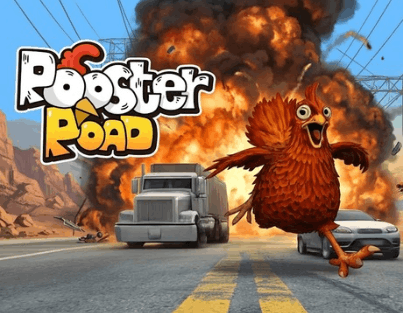
Rooster Road
Rooster Road Mods Game
Please Do Not Feed The Sprunki Brud
Endacopia

Basketball Hit
Flying Car Game Police Games

My Talking Tom Cat But With Oren
Park Fever

Goalheads Io
Flip Or Fail
Classic Sudoku Puzzle

Skillful Finger
Tomb Of The Mask Neon

Boboiboy Galaxy Run

Sprunki Footlongs Sandbox
Hamster Maze
Blobade

Flip Duel
Wheely 2

Obby Tower

Obby Parkour Ultimate

Lazy Bear







How To Play Rooster Road
Rooster Road employs simple control mechanics that are quick to pick up yet challenging to truly excel at. Players are able to navigate the rooster in both forward and backward directions along the path. This two-way movement serves as the fundamental gameplay mechanic. The road itself is never stationary; traffic can approach from the left, the right, or various other angles, while the open areas between vehicles remain in a state of continual flux. As a result, one must carefully monitor the movement of traffic, spot an appropriate opening, and move ahead when the timing is favorable. Recognizing the proper moment to fall back is just as critical. When an oncoming vehicle arrives more swiftly than anticipated, moving back to a prior spot can prevent a crash.
The opening stretches of the road offer a fairly lenient experience, allowing players to familiarize themselves with the game’s tempo. Once the rooster advances further, the amount of traffic grows heavier, and the driving behavior of vehicles turns increasingly unpredictable. Additionally, power-ups appear, granting short-term benefits. Still, such bonuses tend to appear in dangerous zones. The player is then forced to weigh the prospective advantage against the associated risk. In the end, the main goal is to lead the rooster as far down the road as possible. Although every attempt finishes swiftly, the insights gained from each misstep lay the groundwork for a more successful subsequent try.
Rooster Road Wiki
Summary
At first glance, Rooster Road appears to be a simple arcade title built around the timeless "why did the chicken cross the road" idea. In practice, it evolves into a nerve-wracking reflex challenge with considerable stakes. Players take command of a rooster whose goal is to navigate a series of busy thoroughfares filled with cars, trucks, and other vehicles that move at different speeds and approach from multiple angles. Unlike conventional endless runners, where moving forward happens automatically, Rooster Road calls for a far more thoughtful strategy: each step must be carefully timed, every opening must be assessed, and any choice you make can either save you or send you back to the start. The game's charm stems from its uncomplicated design—no need to master complex systems or sit through extended tutorials. Instead, you have a rooster, a road, and an endless stream of traffic. However, this apparent simplicity conceals a remarkably nuanced gameplay experience. Players must decide when to press ahead and when to hang back, when to seize an opportunity and when to let it pass, and when to rely on raw speed rather than patient waiting. As a result, the game welcomes beginners instantly while still offering a meaningful challenge to veterans. Thanks to its quick sessions and progressively tougher conditions, Rooster Road creates an addictive "just one more attempt" mindset that draws players back to the asphalt again and again.
Key Features
Rooster Road sets itself apart through a number of intentional design elements that appeal to enthusiasts of arcade and reaction-based gaming:
- Unpredictable, constantly shifting traffic: Vehicles arrive from various directions, and safe spots are never guaranteed to stay safe. This keeps every session lively and demands continuous attention from the player.
- Strategic forward and backward movement: Unlike many endless runners, Rooster Road allows you to move in both directions. This gives you the freedom to carve out safe paths and retreat when circumstances become too dangerous.
- Steady difficulty progression: Early roads are relatively calm and serve as a gentle learning curve. As you advance, the challenge intensifies with quicker vehicles and narrower openings. This gradual escalation guarantees that players never run out of obstacles to overcome.
- Power-ups with risk-reward trade-offs: Boosts can provide useful benefits, but they tend to be placed in dangerous zones. This creates an ongoing dilemma: chase the bonus or prioritize staying alive.
- High replay value: Since an individual run can end in seconds, the game naturally pushes players to hit retry. The urge to beat your previous best distance serves as a strong incentive, and the mechanics encourage repeated practice and careful observation.
- Clean, no-frills presentation: The visuals and narrative take a backseat to pure gameplay. By stripping away distractions, the game becomes a concentrated evaluation of reflexes and judgment.
Precautions/Tips
Although picking up Rooster Road is easy, reaching impressive distances requires a certain amount of self-control and strategic thinking. The following advice and warnings can help you survive longer and steer clear of frequent errors.
- Avoid rushing. The biggest mistake players make is constantly pushing forward. Instead, hold your position until a safe opening appears, then advance with purpose.
- Survey the entire road. Do not focus solely on the nearest vehicle. Take note of the broader movement patterns so you can anticipate changes and plan your route ahead of time.
- Make use of backward steps. Retreating is not a sign of cowardice; it is a calculated move that can pull the rooster out of harm's way.
- Skip unnecessary power-ups. If collecting a bonus would force you into heavy traffic, leave it behind. Your safety outweighs a brief advantage.
- Remain calm in stressful moments. As the traffic grows more chaotic, panic is your enemy. Breathe deeply and concentrate on the next viable gap.
- Analyze every accident. After you crash, take a moment to review what led to the failure. Did you underestimate a vehicle's velocity? Did you act too soon? Apply those lessons to your next run.
- Develop reflexes gradually. Your ability to read traffic and time movements will improve through consistent practice. The more time you spend with the game, the sharper your instincts will become.
- Set manageable goals. Rather than attempting to clear the entire stretch of road in one bold push, aim to advance one safe gap at a time. This approach lowers stress and leads to smarter decisions.
In the end, Rooster Road is a game that honors patience and careful observation. Those who treat the traffic with respect and fight the urge to take reckless chances will discover a challenging, deeply gratifying experience that keeps drawing them back to the roadside.
Rooster Road Frequently Asked Questions
Q: What exactly is Rooster Road?
A: Rooster Road is an entertaining arcade title in which players guide a small chicken across bustling roadways filled with cars, trucks, and other traffic speeding past continuously.
Q: What goal must the player accomplish in Rooster Road?
A: The main aim is to move the chicken safely to the opposite side of the roadway.
Q: How does the road behave in Rooster Road?
A: The roadway is in constant motion, with vehicles coming from multiple directions. Areas that seem safe can vanish in a flash.
Q: What strategy should a player use to move safely?
A: Rather than dashing nonstop, scan the road ahead and wait for the ideal opportunity to advance. At times, retreating a step is the wisest move to avoid peril.
Q: How does the difficulty change as the game progresses?
A: As you continue further, evasion grows more challenging, and the ever-present traffic keeps generating surprising scenarios.
Q: What are power-ups in Rooster Road, and what is the risk associated with them?
A: Power-ups, also known as rewards, grant useful benefits and add extra fun to the trip. Yet chasing after them can be dangerous when a large number of vehicles stands in your path.
Q: What is the key to surviving longer in Rooster Road?
A: Patience is essential. Avoid charging ahead blindly; instead, study the movement patterns of the traffic, exploit every safe opening, and prepare to turn back whenever needed.
Q: Why is the game appealing to players?
A: The game's charm comes from that persistent "one more attempt" urge. A single run can finish in an instant, which pushes the player to give it another go and beat their prior best.
Q: What should a player do after a failure?
A: Each time you fail, recall exactly where you went wrong and use that knowledge to do better on your following try.
Q: Does the player's skill improve over time?
A: Absolutely. As your reactions sharpen, even routes that once looked hopelessly chaotic become far more manageable.
Q: What is a similar game mentioned in the description?
A: The description refers to Cuby Road as a comparable game.
Q: What are the characteristics of Cuby Road?
A: Cuby Road features straightforward yet demanding arcade action, emphasizing precise control, obstacle avoidance, and fast reactions. Although it is simple to pick up, achieving a high score is quite tough.