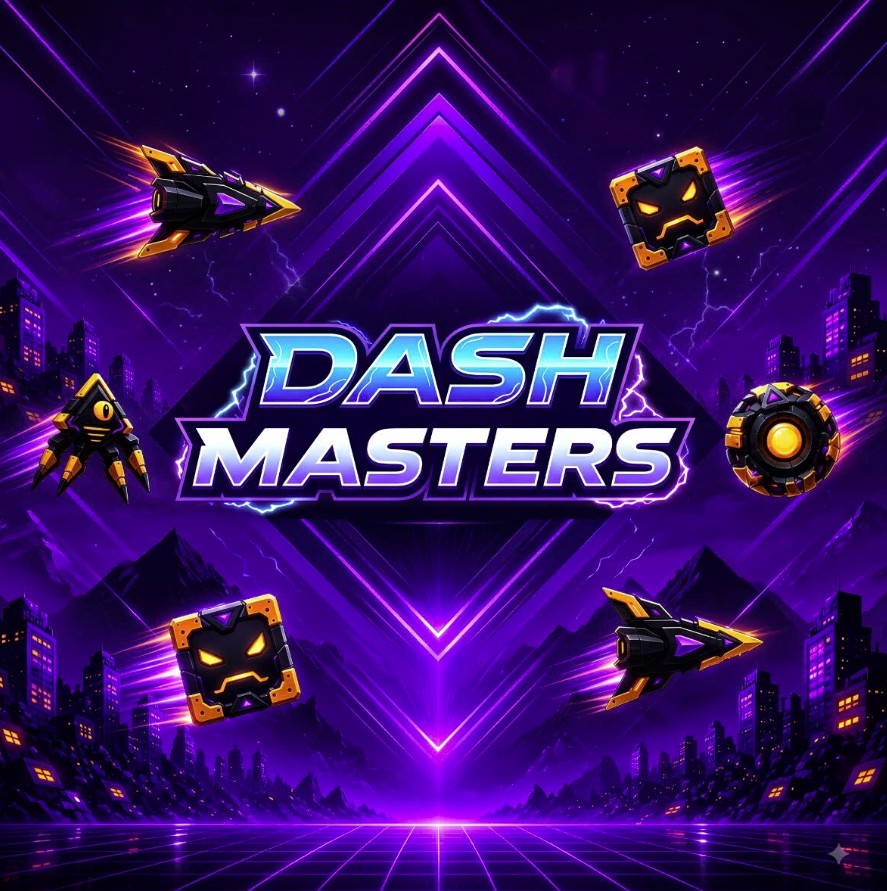
Dash Masters
Dash Masters Mods Game
Zombie Dash
Rainbow Tsunami
Shapik The Quest

Do Dragons Exist
Goat Rampage
Tower Rise
Horror Nun 2
Sprunki Square Shifted
Obby Survive Parkour

Bees Empire Clicker

Paint Or Hunt
Super Bear Adventure
Brave Squad
Sprunki Hyper Shifted Phase 3 Remastered
Left Or Right Spranki Beats
1 Speed Keyboard Lucky Escape
Traffic Racing
Rider Rush
Sprunki Phase 9 Ggtp
Rooster Road

How To Play Dash Masters
Dash Masters
Summary
Dash Masters is a rhythm-driven platformer that combines an elegantly simple control scheme with demanding, music-synchronized level design. It challenges players to guide an automatically advancing icon through obstacle-filled courses while relying on precision, memory, and a strong sense of timing. Though the core mechanic is easy to grasp, mastering each stage requires patience, practice, and close attention to the soundtrack.
How to Play
Fundamentally, Dash Masters revolves around a single-input control scheme. Desktop players can trigger the jump using the mouse, the Spacebar, or the Up Arrow key. On touch devices, tapping anywhere on the display executes the same action. Your icon advances on its own without requiring directional input, so your only task is to land well-timed jumps at the right instant.
Each level is packed with dangers, including spikes, spinning saw blades, and shifting platforms. A single collision with any of these obstacles instantly terminates the attempt and returns you to the beginning. Hence, impeccable timing is the core skill you need to develop.
The placement of obstacles frequently follows rhythmic patterns, with the soundtrack serving as an essential guide. Listen closely to the tempo, as numerous leaps are deliberately synchronized with prominent musical beats. For difficult passages, Practice Mode lets you place checkpoints close to the challenge, allowing you to replay a tricky segment repeatedly without losing progress. Certain areas also contain portals capable of altering gravity, modifying movement velocity, or switching the icon into alternative forms such as a cube, ship, or ball, demanding rapid adaptation.
Key Features
- One-button control: The entire game is built around a single input, making it accessible to everyone while preserving a high skill ceiling.
- Rhythm-based level design: Obstacles, enemies, and jump cues are tightly integrated with the music, creating an immersive audio-visual experience.
- Practice Mode: Place checkpoints at strategic points near difficult sections, enabling focused rehearsal without forcing you to restart the entire level.
- Portal transformations: Dynamic portals can change gravity, speed, or convert the icon into different shapes, adding variety and unpredictability to each stage.
- Hazard-rich environments: Expect to encounter spikes, saws, moving platforms, and other obstacles that test your reaction speed and timing.
Precautions / Tips
- Always listen to the music rather than relying solely on visual cues. The beat often tells you exactly when to jump.
- Make good use of Practice Mode. Set checkpoints before particularly hard passages and repeat them until the motion becomes instinctive.
- Keep your eyes scanning ahead of the icon. Because the character moves continuously, anticipating obstacles early is far more effective than reacting at the last second.
- Do not be discouraged by repeated failures. Each crash provides valuable information about the level’s layout, timing windows, and rhythm.
Summary
Dash Masters offers a polished, demanding challenge for fans of precision platformers and rhythm games alike. Its stripped-down control scheme masks a surprisingly deep experience, while the fusion of music and level design creates a satisfying loop of practice, improvement, and eventual mastery. For those willing to push through difficult stages, Dash Masters is an addictive and rewarding journey.
Dash Masters Wiki
Dash Masters: Precision and Patience in a Rhythm Platformer
Dash Masters has quickly drawn the interest of players who enjoy intense, accuracy-driven platforming challenges. Its design is clearly rooted in the Geometry Dash tradition, but it removes unnecessary systems and concentrates on one essential test: keep moving forward while navigating every obstacle without hesitation. The outcome is a game that feels both straightforward and meaningful, requiring quick reflexes as well as a strong sense of timing and the ability to recognize patterns. Whether you are already at home with rhythm games or are just beginning to explore arcade-style challenges, Dash Masters delivers a clean and rewarding experience. The sections below cover the core concept, the gameplay style, the defining features, and the most useful advice for improving your performance.
Summary
Dash Masters is a dynamic rhythm platformer built around an icon that moves continuously through levels filled with hazards. It blends the exactness of geometric platforming with musical feedback, asking players to rely on timing, memory, and nearly instant reactions. The route is packed with spikes, rotating blades, moving threats, and portals that bend gravity, all set against a driving soundtrack. The objective is simple: guide the icon from the start of the level to the end without colliding with anything. Every failure leads to an immediate restart, which encourages you to learn from each mistake and gradually memorize the correct route. The experience takes direct inspiration from Geometry Dash, refining the rhythm-platformer formula into a polished and accessible package. Rather than rewarding random button presses, the game favors steady rhythm and careful observation. Each death contains a lesson, and every victory is achieved through genuine mastery.
How to Play
Learning the basics of Dash Masters is easy, but reaching a high level of skill takes time. The controls could not be more minimal. On PC, you can jump by clicking the mouse, pressing the Spacebar, or using the Up Arrow key. On mobile, a simple tap on the screen does the same thing. Your character is always moving forward, so acceleration and braking are never part of the equation. In fact, the entire gameplay loop comes down to one decision: when to jump.
That simplicity is deceptive. Every spike, blade, and platform must be handled with exact timing. A jump that lands even a single frame too early or too late usually means the end of the run. As you progress, the game introduces new mechanics to keep you alert, and portals are the most significant of these. Some portals flip gravity, forcing you to rethink your orientation instantly. Others change your speed, meaning the distance covered by a jump suddenly shifts. Still others transform your icon into a different form, such as a cube or a ship-like state, each with its own physics. These changes demand quick adaptation and a thorough understanding of the game’s core movement.
One of the most valuable tools available to you is Practice Mode. This mode allows you to place checkpoints anywhere in a level, so you can focus on a single difficult segment without replaying the entire stage. Practice Mode is not a workaround; it is a strategic necessity. The levels are long and demanding, and trying to learn a late-game section through repeated full runs is inefficient. By isolating the hardest portions, you can give your full attention to the exact jump timings and portal transitions. Once those moments become automatic, you can connect them into a full run.
The most important skill to develop is rhythm. Because Dash Masters lines up its obstacles with the musical beat, players who rely only on what they see will quickly feel overwhelmed. Counting the music in your head helps you commit jump timings to memory. The early levels ease you into this mindset with larger gaps and slower tempos. Later stages require faster and more precise responses, and the soundtrack becomes an essential guide rather than background noise.
Key Features
Dash Masters looks minimal from the outside, but its features are carefully chosen to add depth and variety within a simple structure. These are the defining aspects of the experience.
-
Simple yet responsive controls: The control scheme is intentionally sparse. A single jump input on PC or mobile eliminates mechanical clutter and places all the challenge on timing. This results in a clean, satisfying feel for players who appreciate skill-based arcade gameplay.
-
Continuous forward motion: The icon never stops, and you cannot change its speed or direction. Your only option is to time your jumps based on what appears ahead. This constraint is the heart of the challenge, forcing you to think ahead, watch the path, and prepare mentally for each new obstacle.
-
Portals and transformation mechanics: Some sections include portals that completely alter how the icon behaves. A gravity-reversal portal turns the stage upside down, requiring you to land on ceilings. A speed portal accelerates or slows the action, changing the timing of every jump that follows. These mechanics keep the game from feeling repetitive and add an extra layer of strategy, especially when multiple portals appear in quick succession.
-
Rhythm-based level design: Obstacles are not placed at random. The stage layouts are synchronized with the music, so many jumps feel like beats in a composition. This coordination is more than an artistic choice; it gives players a reliable timing reference. Those who can feel the beat will find the game more intuitive and far less chaotic.
-
Practice Mode: This mode is essential for anyone serious about clearing difficult levels. It lets you set checkpoints and repeatedly attempt a short portion of the stage without restarting from the beginning. Rather than being an extra feature, it serves as a training tool for pattern recognition and muscle memory development.
-
Scalable difficulty curve: Dash Masters begins with enough breathing room to teach the basics, then gradually introduces faster tempos, denser hazards, and more complex portal combinations. The curve is built to give you a sense of real progress while still offering a stiff challenge to experienced players.
Precautions/Tips
Success in Dash Masters relies on mental preparation, familiarity with the course, and controlled reflexes. The first and most important piece of advice is to treat failure as a learning tool rather than a setback. Every crash is valuable information: it tells you that your jump was too early, too late, or out of sync with the music. The sooner you accept death as a normal part of the learning process, the faster you will improve.
One of the most effective strategies is to listen to the music with real intention. Rather than focusing only on the visual hazards, try to recognize the underlying beat structure. Many obstacles align with downbeats and rhythmic accents. If you keep missing the same jump, try closing your eyes for a moment and feeling the pulse of the track. You may find that your body knows when to jump even before your conscious mind processes the obstacle. This kind of audio-motor coordination is central to the Dash Masters experience.
When dealing with portal sections, it helps to break them down mentally. A gravity reversal or speed shift does not change the physical layout, but it changes your relationship to that layout completely. Practice these transitions in Practice Mode until your hands adjust naturally. It is also wise to stay aware of what lies immediately after a portal, because the first jump following a mechanic change is often the most dangerous.
Precautions/Tips
Dash Masters can be mentally demanding. The tiny margin for error and the need for precise timing can quickly lead to frustration. The most important tip is to remain calm and treat every attempt as a small experiment. Instead of expecting an immediate clear, focus on advancing one obstacle at a time. Memorizing the pattern of a level is not a shortcut; it is an essential part of the intended experience.
When approaching a new section, try to identify a clear reference point, such as a specific musical cue, a visual mark on the ground, or the edge of a platform, that signals your jump. Anchoring your timing to consistent signals lowers the chance of jumping too early or too late under pressure. The same idea applies when a speed portal changes the pace; both the visual cues and the rhythm shift, so you cannot rely only on what worked in the previous segment.
If you feel stuck, the best move is to step away briefly. Fatigue weakens your reflexes and concentration, and continuing to play while frustrated often leads to careless mistakes. Returning with a fresh mind can make a difficult area feel significantly more manageable. You should also pay attention to your equipment. A crisp, responsive mouse or a stable touchscreen can make a real difference in a game where timing is measured in fractions of a second.
Finally, do not ignore the audio. Playing without sound removes one of the most important feedback systems the game offers. The music is not decoration; it serves as a map to the level’s layout. For maximum control, keep the volume at a comfortable level and let the beat settle into your muscle memory. Over time, your jumps will feel less like calculations and more like natural responses, which is exactly the mindset that Dash Masters is designed to create. With persistence, discipline, and a good ear, even the most punishing courses can be conquered.
Dash Masters Frequently Asked Questions
Q: What exactly is Dash Masters?
A: Dash Masters is an energetic rhythm-based platformer that draws inspiration from the core mechanics of Geometry Dash. Players guide a continuously moving icon and must respond swiftly to various obstacles in their path.
Q: What is the primary objective in Dash Masters?
A: The main objective is to make it from the start of a level all the way to the finish line without colliding with anything.
Q: Which controls are available on PC?
A: On a PC, players can jump by clicking the mouse, pressing the Spacebar, or using the Up Arrow key.
Q: How do you control the game on mobile devices?
A: On mobile, simply tap the screen to jump or perform other interactions.
Q: Is the player character in constant motion?
A: Yes, the icon automatically moves forward at all times without any manual input required for movement.
Q: What kinds of hazards might players encounter in Dash Masters?
A: The game features a variety of dangers, including spikes, spinning saws, moving platforms, portals, and numerous other threatening elements.
Q: What effect do portals have on the gameplay?
A: Portals are capable of altering gravity, adjusting speed, or switching the current form of movement the player is using.
Q: In what way does music assist the player in Dash Masters?
A: The soundtrack serves as a critical rhythmic guide, offering valuable cues that allow players to predict and prepare for many upcoming obstacles.
Q: What purpose does Practice Mode serve?
A: Practice Mode gives players the opportunity to reduce speed and master challenging patterns step by step, which proves especially useful when a particular section seems nearly impossible to pass.
Q: Does the level of difficulty increase over time?
A: Absolutely—as players advance, movement becomes quicker and level designs become more tricky, resulting in progressively harder attempts.
Q: Why is Dash Masters considered a rhythm-based experience?
A: The gameplay is closely synchronized with the music, and relying on rhythmic cues greatly improves the timing of jumps and the ability to foresee hazards.
Q: What is the most effective method for learning difficult patterns?
A: Consistent practice through repeated attempts enables players to memorize patterns, while Practice Mode offers a focused way to tackle each obstacle individually.