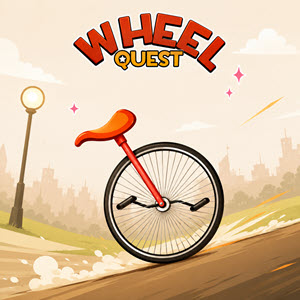
Wheel Quest
Wheel Quest Mods Game

Snail Bob 8

Airborne Bmx

Hexbound

Muscle Up Master

Mr Macagi Adventures

Poople

Brainrot Hole

Color Tunnel 2

Battalion Commander 2

Flowball

Sprunki Cute Time Ultimate

Sprunki Summer Time

Sprunki Fire Warm

Sprunkilarity3

Sprunki Jevin Treatment

Hill Sprint

Cat Life Simulator

Fireboy And Watergirl 6 Fairy Tales

Baldis Basics Classic Remastered

Mineland












How To Play Wheel Quest
The core gameplay experience of Wheel Quest revolves around one central, yet highly challenging, mechanism: preserving equilibrium while riding a moving unicycle. The cyclist is perpetually shifting their weight in reaction to the wheel’s movements, compelling players to execute subtle, accurate adjustments to ensure the character remains upright. The essential path to achievement depends on interpreting the landscape and responding with soft, well-timed commands. Beyond this primary focus, mastering the game involves anticipating changes in surface elevation and modulating momentum, as even a minor misjudgment can lead to a loss of control. Consequently, success in Wheel Quest demands a consistent commitment to focus and a refined sense of timing, making each session a test of both patience and dexterity.
Wheel Quest Wiki
Summary
Wheel Quest is a physics-driven unicycle game that presents participants with an apparently straightforward aim: maintain an upright position and traverse the greatest possible distance. The entire experience centers on the subtle craft of equilibrium, where each motion, incline, depression in the road, and leap introduces a fresh chance for the rider to lose balance and fall. The game’s primary allure stems from its unpredictable physics simulation, which encourages deliberate, cautious handling and penalizes excessive adjustments or slow responses. As participants advance, they face more challenging surfaces and gain access to additional unicycles, offering a lasting motivation to surpass their own top travel distance. Even with its streamlined commands and simple concept, Wheel Quest delivers a surprisingly intricate challenge that examines both reflexes and thoughtful endurance. It is a creation meant for those who value the interplay between straightforwardness and difficulty, where achievement is gauged not by completed stages but by meters survived. Overly forceful corrections can trigger a wobble that rapidly escalates into a tumble, while hesitant reactions leave the cyclist subject to gravitational forces.
Participants start on level terrain, letting them create a steady pace and become familiar with the core mechanics. As the path extends, the roadway introduces depressions that disrupt the wheel’s steadiness, gradients that modify speed and trajectory, and leaps that necessitate a stable touchdown. Each of these impediments calls for a distinct method: foreseeing a depression by modifying the tilt before contact, shifting body weight suitably on a slope, and bracing for the landing’s impact to cushion the jolt.
The commands are intentionally stripped down, allowing players to concentrate entirely on maintaining equilibrium. On a computer, the left and right directional keys are employed to tilt or shift the rider. On handheld gadgets, pressing the left or right side of the display accomplishes the same result. The straightforwardness of the input method masks the intricacy of the gameplay, as every press must be deliberate and meaningful.
The game advises players to begin at a low pace and thoroughly observe the rider’s tilt angle. Brief, quick presses are more successful than keeping a direction held for a lengthy period, since they enable finer handling and swifter adjustments. It is also essential to watch the path ahead—getting ready for upcoming obstacles early is considerably simpler than trying to recover stability at the final instant. Rough segments should be approached with care, and players should modify their stance before reaching slopes or jumps. The primary aim is to steadily enhance one’s distance, treating each additional meter as a personal triumph.
Key Features
- Realistic Equilibrium System: The fundamental mechanism is based on an authentic physics engine that mimics the rider’s tilting and the wheel’s forward motion. Every command has a matching effect, rendering the experience both instinctive and uncompromising.
- Changing Landscape Challenges: The roadway is not consistent. Depressions, gradients, and leaps regularly break the player’s flow, demanding flexible tactics and rapid cognition. The terrain grows more demanding as the participant proceeds, making certain the difficulty escalates naturally.
- Obtainable Unicycles: As players travel longer distances and reach superior results, fresh unicycles become accessible. These visual or performance variations add replay worth and give players a concrete prize for their persistence.
- Streamlined Controls with High Mastery Threshold: The command arrangement is extremely basic—just two directions—yet perfecting it demands fine motor coordination and split-second choices. This opposition between ease and challenge is a defining trait of the game’s layout.
- Limitless Track Framework: The game lacks set levels or finishing points. The sole objective is to continue cycling and surpass your prior top distance. This setup promotes repeated attempts and personal growth rather than sequential advancement.
- Multi-Device Accessibility: The game operates entirely on both PCs (with directional keys) and portable gadgets (with screen touches), making it available to a broad spectrum without diminishing the fundamental experience.
Precautions/Tips
- Refrain from Excessive Adjustment: A frequent error is responding too forcefully when the cyclist begins to tilt. A big, prolonged input can increase the wobble rather than fix it. Utilize short, gentle taps to guide the rider back to a secure posture.
- Predict, Do Not Respond: The most adept participants keep their gaze on the path ahead. By recognizing gradients, depressions, and jumps several seconds beforehand, you can modify your equilibrium before the obstacle impacts the wheel. Last-instant fixes are seldom effective.
- Keep a Consistent Pace: On level portions, aim to discover a comfortable, steady tapping rhythm. This assists you in creating a baseline of steadiness that can endure small disturbances. Altering your rhythm unexpectedly can result in lost command.
- Execute Jumps with Caution: When nearing a jump, get ready for the landing by centering the rider’s tilt. The impact moment is crucial—if you are leaning excessively in any direction, the touchdown will nearly certainly cause a fall. Strive to land with the wheel as horizontal as feasible.
- Gradual Enhancement: Do not anticipate doubling your distance in a single effort. Concentrate on advancing by a few meters each attempt. This method decreases irritation and builds a consistent feeling of achievement. Even a minor improvement counts as a success.
- Pause Periodically: The game’s mechanics can be psychologically demanding. If you notice yourself committing repeated errors, take a short break. Coming back with a refreshed mindset frequently results in improved performance.
- Test Various Unicycles: Different unicycles might feature slight differences in physics or handling. Explore them to determine if any match your playing technique better. Unlocking and trying new choices can also reduce repetitiveness and provide renewed drive.
- Monitor Your Grip (When Using a Handheld Device): Holding the gadget in a fixed position can assist you in managing screen touches more precisely. Shaky hands can translate into unstable in-game equilibrium.
Wheel Quest Frequently Asked Questions
Q: What is Wheel Quest? A: Wheel Quest is a unicycle experience based on physics, where you maintain equilibrium on a single wheel and strive to advance as far as possible without toppling. The difficulty arises from unpredictable ground conditions, such as holes, inclines, and leaps.
Q: What is the main objective in Wheel Quest? A: Your goal is to balance with caution, travel the maximum distance, and surpass your personal best record.
Q: How does the physics work in Wheel Quest? A: As the wheel moves, your rider constantly tilts, requiring you to make small adjustments to keep everything steady. Applying too much force can cause shaking, and reacting too slowly leads to a fall.
Q: What types of terrain can I expect in Wheel Quest? A: You will come across flat stretches for maintaining rhythm, uneven surfaces, holes that disrupt balance, inclines that alter momentum, and leaps that demand controlled landings.
Q: Are there rewards for traveling farther in Wheel Quest? A: Yes, as you progress further, more difficult paths and extra unicycles become accessible, providing further motivation to pursue a higher score.
Q: What is the basic strategy for playing Wheel Quest? A: Begin at a slow pace and watch your rider's tilt closely. Use gentle inputs rather than holding a single direction for too long. When the character starts leaning, perform a swift adjustment before the shake turns into a complete spill.
Q: How should I approach uneven ground in Wheel Quest? A: Focus on the path ahead and get ready for inclines or holes early. It is far simpler to prepare in advance than to attempt saving your unicycle at the final moment.
Q: What are the PC controls for Wheel Quest? A: Press the Left Arrow key to tilt or shift left, and press the Right Arrow key to tilt or shift right.
Q: What are the mobile controls for Wheel Quest? A: Touch the left portion of the display to tilt or shift left, and touch the right portion of the display to tilt or shift right.
Q: What is a key tip for maintaining better control in Wheel Quest? A: Use brief taps rather than extended presses to retain superior control and adjust your balance early.
Q: How should I handle rough sections in Wheel Quest? A: Navigate rough areas with care and reposition yourself before encountering inclines or leaps.
Q: What mindset should I have when trying to improve my distance in Wheel Quest? A: Concentrate on gradually bettering your past distance. Even a few extra meters represent a success when your only companion is an extremely unsteady wheel.
Q: What makes Wheel Quest challenging despite its simple controls? A: The game keeps its inputs minimal yet its difficulty remarkably high. The straightforward but unpredictable physics make staying upright a demanding task.
Q: What should I do when my rider starts tipping in Wheel Quest? A: Execute a fast adjustment before the shake escalates into a full-blown fall.
Q: What other games are similar to Wheel Quest? A: Additional games to explore include Wacky Steps and Slope Xtreme.